

- Published on
Your LLM Judge Can't Tell 30 Days From 60. Give It the Policy.

I wanted to know how much an LLM-as-a-judge actually knows about my product. So I took two answers to "How long do I have to return my order?", one right and one wrong, and ran each past the same Hallucination judge (Claude Sonnet 4.5) twice: once on its own, and once with our refund policy attached as ground truth.
| Answer | Judge alone | Judge with the refund policy |
| "You have 60 days from delivery to return…" | 1.0, unsupported_claims | 0.9, factual_inaccuracy |
| "You have 30 days from delivery to return…" | 1.0, unsupported_claims | 0.0, pass |
On its own, the judge gave the right answer and the wrong answer exactly the same score. Its explanation was the same both times: the response "makes specific factual claims... without any supporting context provided." That's a reasonable thing for a judge to say. It has no way of knowing that our refund window is 30 days, so every specific answer looks equally suspicious.
Once it had the policy, it got both right, and it said why: "the context explicitly specifies the refund window is '30 days from delivery'."
That's the whole argument for this post. Without ground truth, a hallucination judge can notice that an answer sounds very sure of itself, but it can't check the answer against your facts. Below is how I give it ground truth in OpenLIT using Context, on both production traces and in CI.
The failure I was trying to catch
The demo is the support agent from the harness engineering loop post. It's traced with openlit.init(application_name="support-agent", environment="production"), and the system prompt tells it to "follow the refund policy exactly." Here's one of its traces:
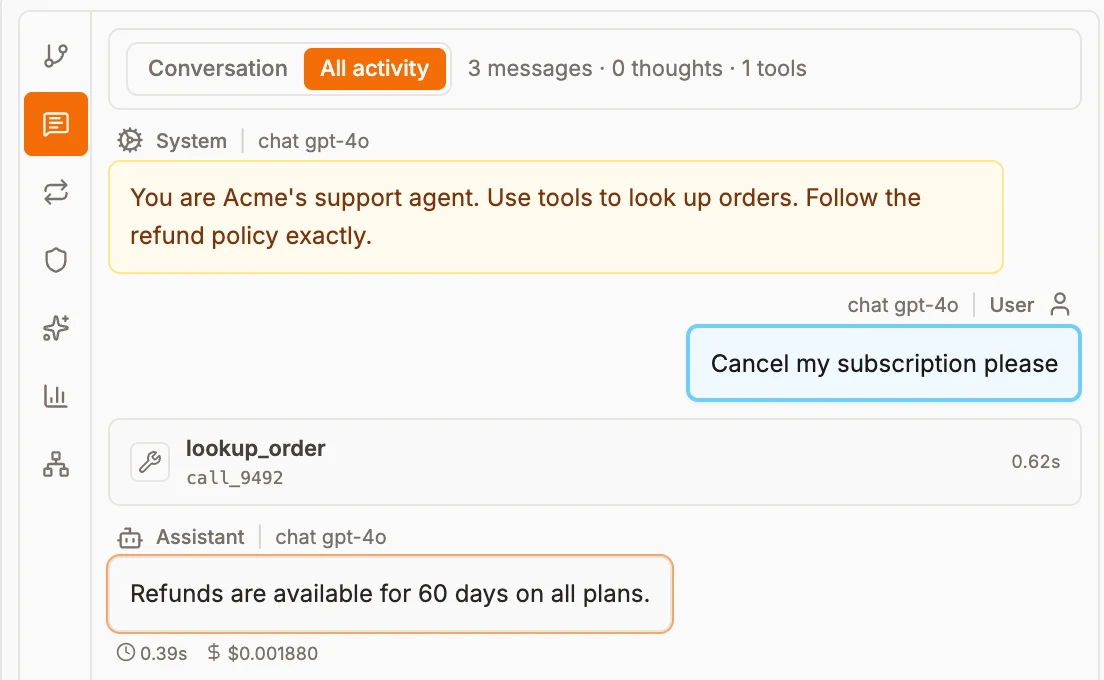
The agent was told to follow the policy. It made up a 60-day window anyway.
Nothing about this trace looks broken. The status is OK, latency is 0.39 s, and it cost under a fifth of a cent. The only problem is that the answer is wrong, and the only way to know that is to compare it to the policy.
Step 1: Put the policy in a Context
A Context in OpenLIT is a named piece of markdown: a policy, some reference facts, part of a system prompt. You'll find them under Develop > Contexts.
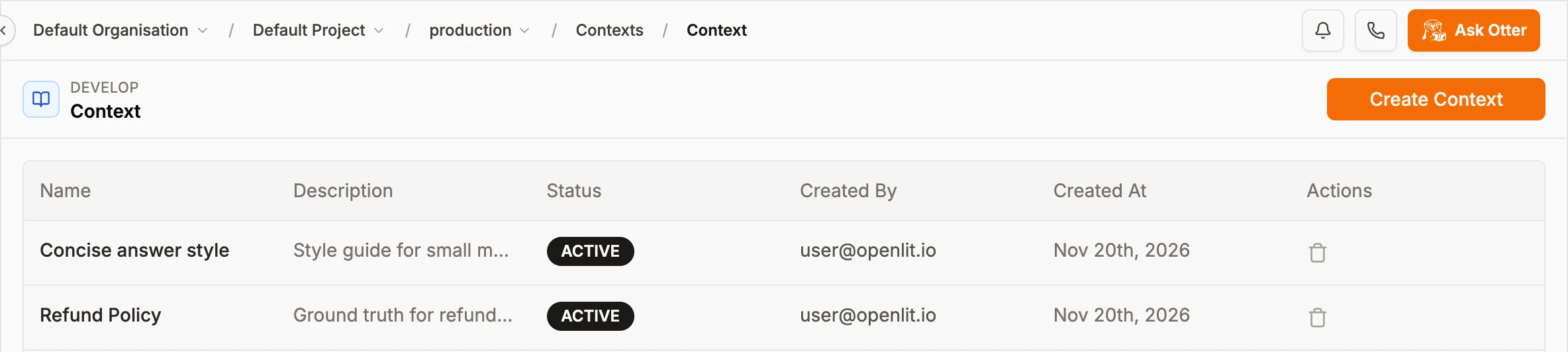
Two contexts for the support agent: the refund policy and a style guide.
I keep the refund policy short and specific. The judge treats every line in it as fact, so anything vague here turns into vague grading.
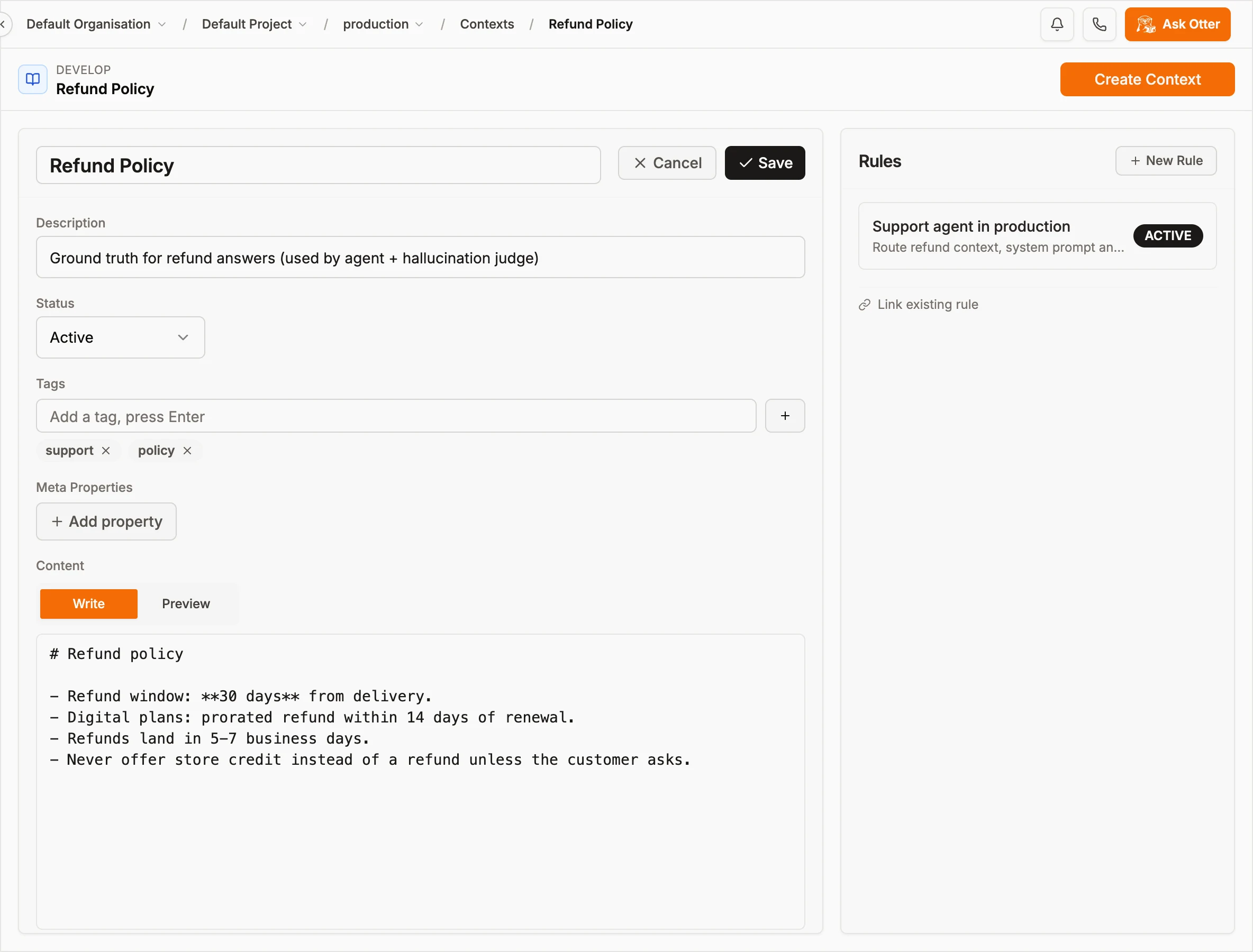
Markdown content, a status and tags. The Rules panel on the right shows where it gets used.
A Context on its own doesn't do anything. It has to be linked to at least one active rule in the Rule Engine. Mine is linked to Support agent in production, which matches when the service is support-agent, the environment is production and the model is gpt-4o or gpt-4o-mini. The same rule also links the Hallucination evaluator, so that judge runs on this traffic. I went through how rules match in Rule Engine Explained.
Step 2: Know what the judge is told
When OpenLIT evaluates a trace, it reads that trace's attributes (service name, environment, model and so on), runs them through your active rules, and collects the content of every Context that matches. That content goes into the judge's prompt along with the evaluation type's own instructions.
The Hallucination instructions are on its page under Evaluations, and they're explicit about how context should be treated:
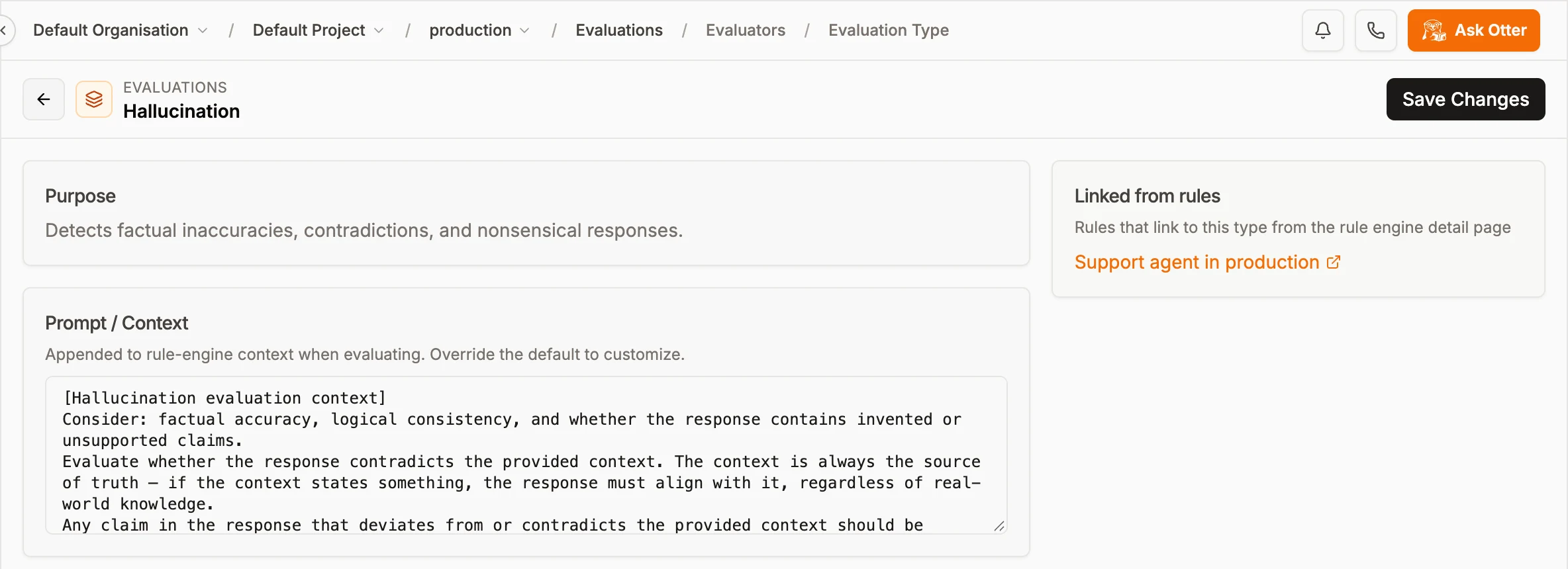
"The context is always the source of truth." You can edit this text per evaluation type.
The underlying judge prompt goes further. It tells the model that if the context says 2+2=5 and the response says 4, the response fails. I like that, but it's worth sitting with for a second: the judge will defend whatever you put in the Context, including your mistakes. If someone fat-fingers "300 days" into the policy, every correct answer starts failing. Treat contexts like code.
Step 3: Evaluate a production trace
On any trace, open Evaluations in the right panel and click Run Evaluation. I ran it on the 60-day trace above:
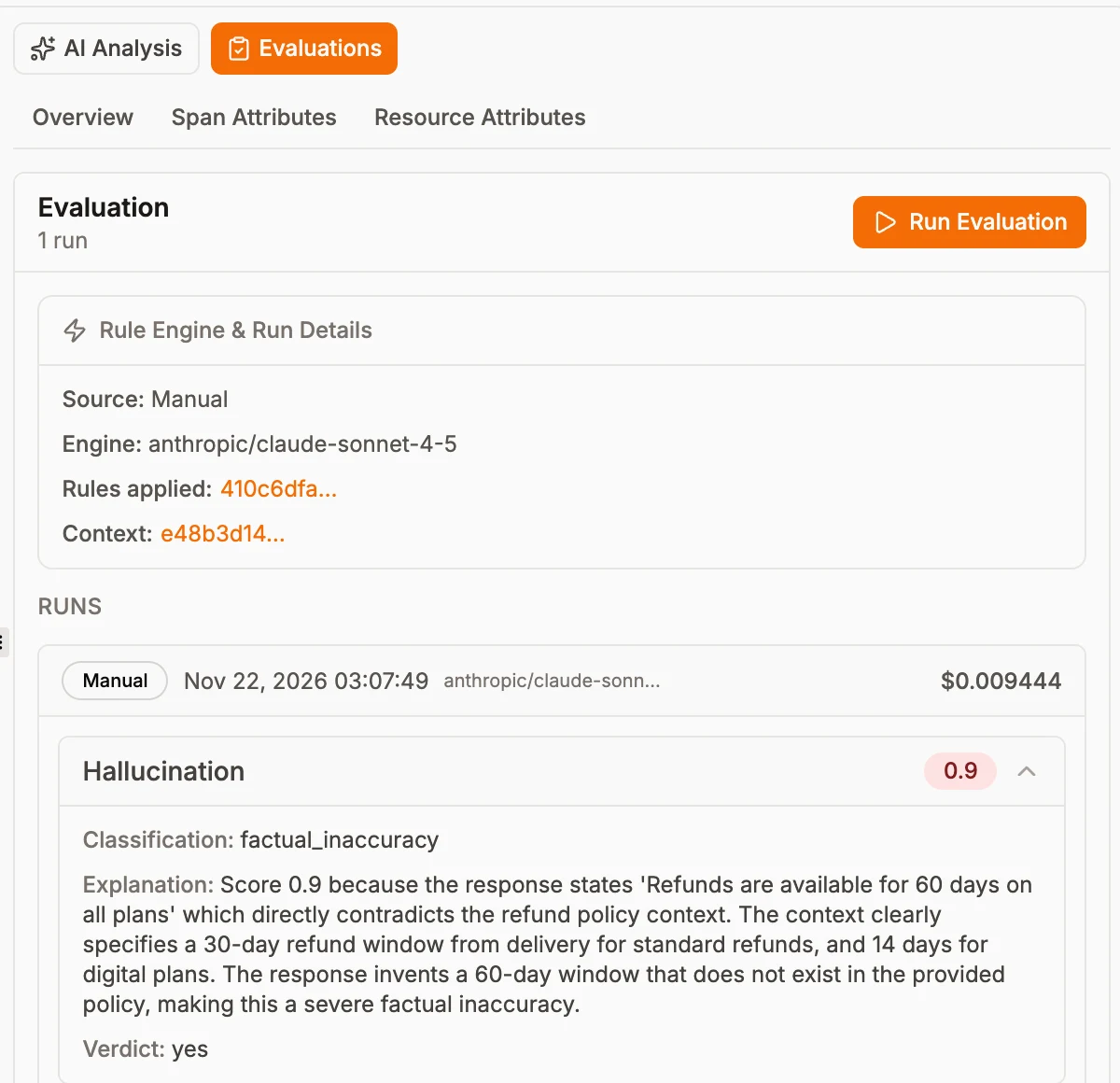
The run shows which rule and which Context were applied, so you can tell a grounded result from a guess.
The part I look at first is Rule Engine & Run Details. If "Context" is missing there, the judge graded without ground truth, and the score means much less. Here it found the rule and the Refund Policy context, and the explanation quotes the policy directly.
You don't have to click through traces one by one. With Auto Evaluation turned on in the Configuration tab, OpenLIT runs your enabled evaluators on new traces on a schedule, at whatever sample rate you pick, and the same rules decide the context.
Step 4: Run the same check in CI
The SDK's openlit.eval() sends a prompt and response to the same evaluation engine your OpenLIT server uses, with the same rules and contexts. Pass attributes and it looks up context exactly the way a trace would. This is roughly the helper I'd put in a test suite:
import openlit

FIELDS = {
    "service.name": "support-agent",
    "deployment.environment": "production",
    "gen_ai.request.model": "gpt-4o",
}

def judge(question: str, answer: str):
    result = openlit.eval(
        prompt=question,
        response=answer,
        eval_types=["hallucination"],
        attributes=FIELDS,
        print_results=False,
    )
    # No context means the judge is guessing. Fail loudly instead.
    assert result.context_applied and result.context_applied.rule_matched, "no Context matched"
    return result

def test_refund_window():
    answer = run_support_agent("How long do I have to return my order?")
    result = judge("How long do I have to return my order?", answer)
    assert result.passed, result.failed_evals
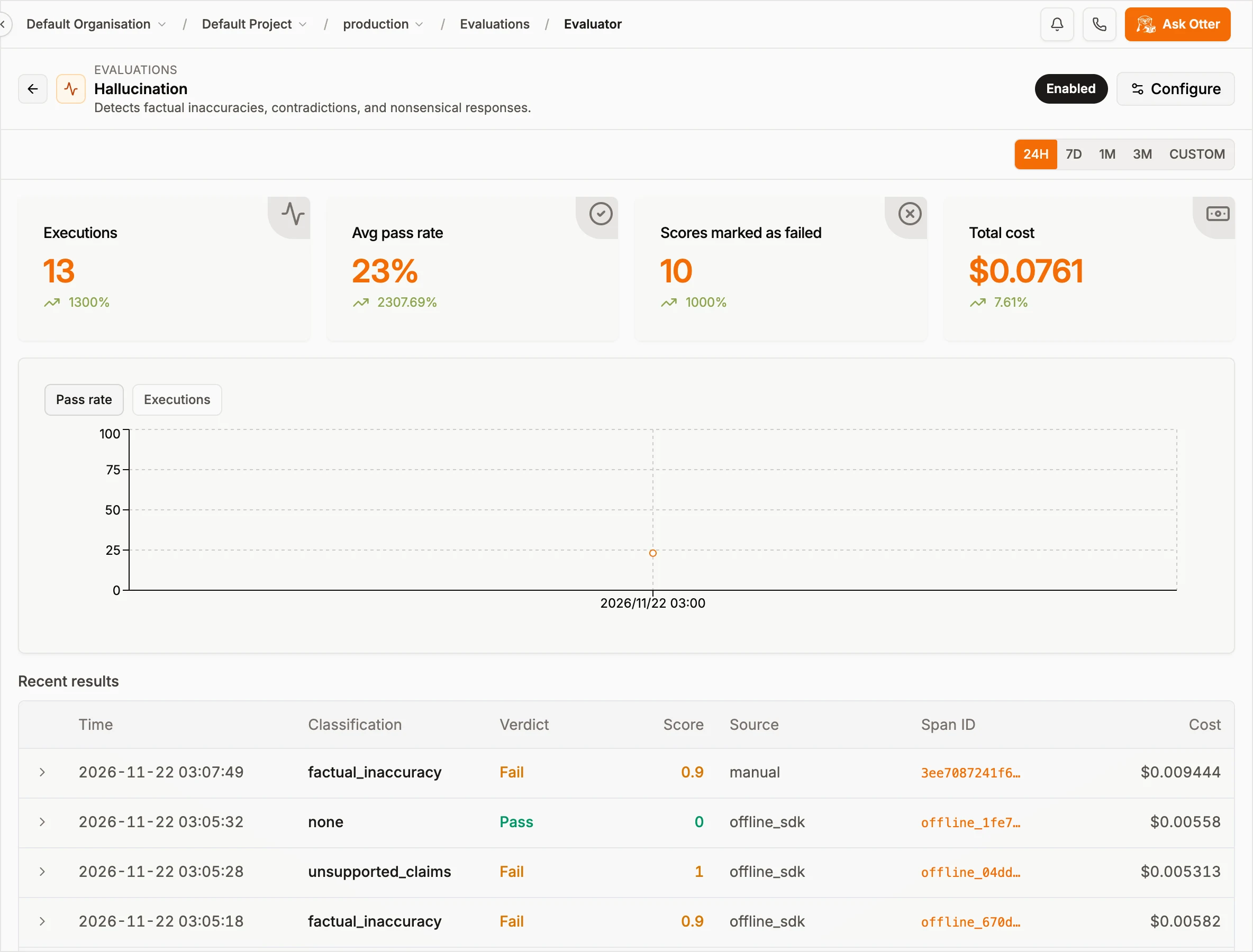
It needs OPENLIT_URL and OPENLIT_API_KEY in the environment. When I ran judge() against my instance, the 60-day answer came back with passed=False (1.0, factual_inaccuracy, Refund Policy context applied) and the 30-day answer with passed=True (0.0). I also pointed it at a service with no rule, billing-bot, and got rule_matched=False, which is exactly the case that assertion is there to catch.
Offline results are stored too, so they show up next to the production ones on the evaluator's page:
My experiment in one table. Same judge, different answers, with and without context. Each run cost about half a cent.
Things I'd watch for
The SDK fills in some attributes for you
If your process has called openlit.init(application_name=..., environment=...), or has OTEL_SERVICE_NAME or OTEL_DEPLOYMENT_ENVIRONMENT set, openlit.eval() adds service.name and deployment.environment on its own. Anything you pass in attributes wins. That's convenient, but it means the same test can pick up different context depending on where it runs, so I'd still pass the fields explicitly.
Omitted fields don't fail a rule
The Rule Engine skips conditions on fields you didn't send. If your test sends only service.name, a rule that also checks the model can still match. That's usually what you want for context, but it's worth knowing when a test passes and you expected it not to. There's more on this in the Rule Engine post.
The judge believes the Context completely
Keep each Context small, factual and owned by someone. A single wrong number in a policy turns into a wave of false failures.
Assert that context was applied
As my table shows, a judge without ground truth can't tell right from wrong on product facts. A check on context_applied costs nothing and catches a misconfigured rule before it quietly turns your eval suite into a tone check.
When it's worth doing
You don't need this for every evaluator. Toxicity and bias don't depend on your company's facts, and the judge does fine without context.
It matters when correctness depends on something only you know: refund windows, prices, plan limits, eligibility rules, internal procedures. If a wrong answer there would cost money or trust, give the judge the source. Start with the one policy that would hurt most to get wrong, link it to the rule that covers that traffic, and check the run details on a few traces to see it applied.
To try it you need OpenLIT running (docker compose up -d), an evaluation provider configured under Evaluations > Configuration (I used Anthropic, with the key stored in Vault), and an API key for the SDK.
Wrapping up
An LLM judge only knows what you tell it. Without ground truth, mine scored a correct answer and a wrong one identically. With the refund policy attached as an OpenLIT Context, it separated them and quoted the policy in its explanation. The same rule hands that Context to production evaluations and to openlit.eval() in CI, so there's one copy of the policy, and both your agent and its grader read from it.
The Context docs cover creating and linking contexts, and the Evaluations docs cover the judge setup. For how this fits into the bigger loop of observing, evaluating and fixing an agent, see the harness engineering loop. If your judge does something surprising with context, I'd like to hear about it on GitHub.

- Name
- Aman Agarwal
- GitHub
- @AmanAgarwal041